Plants
Dumb Cane
Dieffenbachia seguine · Araceae (Aronstabgewächse)
Dieffenbachia is one of the most striking foliage plants for living spaces: large, variegated leaves that play with the light, and an upright, tropical habit. In our Duesseldorf-Pempelfort workshop we value it as a low-maintenance office plant that holds up reliably even in fairly subdued light. Important to know: it is toxic and belongs somewhere children and pets cannot reach.
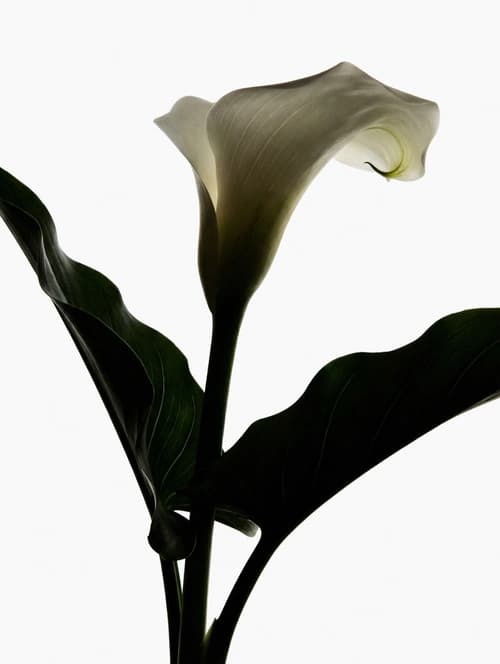
- Light
- Bright and indirect, without harsh midday sun; tolerates partial shade too, though variegated cultivars need more light.
- Watering
- Keep evenly slightly moist, letting the top centimetres dry out; avoid waterlogging and water more sparingly in winter.
- Care level
- Easy
- Botanical
- Dieffenbachia seguine
The genus comprises numerous cultivars that differ mainly in leaf markings and growth height. Cream-speckled types such as Camille and Tropic Snow are very popular, while cultivars like Reflector or Compacta score with a more compact habit and high-contrast veining. Most plants reach 60 to 150 centimetres in indoor culture, and a few older specimens become tree-like over time.
In floristry and interior planting we use Dieffenbachia as a solitary structural plant, for instance as a green focal point in entrances, surgeries and offices. Its broad leaves fill volume without feeling intrusive and pair well with plain pots in anthracite, terracotta or matte white. It is of little use as cut greenery; its value lies clearly in the living plant.
Quality shows in firm, glossy leaves without brown edges and in a strong, straight stem. When buying at the Veiling Rhein-Maas we make sure the plants are well rooted and free of spider mites, because only a vigorous starting plant stays beautiful for years. Yellowing lower leaves are normal on older specimens and not a defect.
Stylistically Dieffenbachia fits perfectly into a modern, urban green concept and combines well with other aroids such as Monstera, Philodendron or Peace Lily. Planted in groups it quickly creates a dense, tropical atmosphere; placed singly it appears calm and architectural. For brighter spots choose strongly variegated cultivars, while greener types cope better with darker corners.
Is Dumb Cane toxic to children and pets?
- Children
- Toxic
- Cats
- Toxic
- Dogs
- Toxic
Toxic to people and pets. The sap contains calcium oxalate and irritates skin and mucous membranes; if swallowed it can cause swelling in the mouth and throat. Keep out of reach of children and animals.
Typical symptoms: Intense burning and swelling of the mouth, tongue and throat, drooling, vomiting and difficulty swallowing.
In an emergency:call the German poison control centre in Bonn on +49 228 19240 (24/7) — for pets, contact an emergency vet directly. This information does not replace medical or veterinary advice.
Overview: toxic & non-toxic plants for cats, dogs and children
Care
- 01Bright position without harsh midday sun: bright, indirect light is ideal, while direct sun scorches the leaves.
- 02Keep the soil evenly slightly moist, letting the top two to three centimetres dry out between waterings; always avoid waterlogging.
- 03Keep warm at 18 to 24 degrees and protect from draughts and cold windowsills in winter.
- 04Higher humidity benefits the plant; occasional misting or a spot away from radiators prevents brown leaf edges.
- 05Feed weakly every two to four weeks from spring to late summer; wear gloves when repotting and pruning, as the sap irritates skin and mucous membranes.
Frequently asked
- Is Dieffenbachia toxic to cats, dogs and children?
- Yes, Dieffenbachia is distinctly toxic. Its sap contains calcium oxalate, which irritates skin and mucous membranes and can cause swelling of the mouth, tongue and throat if swallowed. Keep the plant out of reach of children and pets and wear gloves during care.
- Why does my Dieffenbachia get yellow or brown leaves?
- Yellow leaves usually point to overwatering and waterlogging, while brown tips or edges indicate dry air or too little water. A few yellowing lower leaves are normal on older plants. Check your watering, the humidity and the distance to the radiator, and the foliage will recover quickly.
- How much light does Dieffenbachia need and can it tolerate dark corners?
- It thrives best in a bright spot with indirect light, for example a few metres from a south window or directly at an east or west window. It tolerates partial shade well, but in very dark corners the variegation fades and growth becomes sparse. For darker positions greener cultivars are better suited than strongly white-marked ones.
- Is Dieffenbachia available all year round?
- Yes, as a classic houseplant Dieffenbachia is available all year round. We source it in A1 quality directly via the Veiling Rhein-Maas, so we can offer strong, well-rooted plants that bring joy for many years.