Flower Library
Fritillary
Fritillaria imperialis · Liliengewächse (Liliaceae)
Fritillary is one of the most striking spring flowers of all: tall stems, a whorl of nodding bell-shaped blooms and a green tuft of leaves crowning the top. As cut material it is available only a few weeks a year, which is why we deliberately select flawless A1 stems at the Rhein-Maas auction. Once seen in a bouquet, its silhouette is unforgettable.
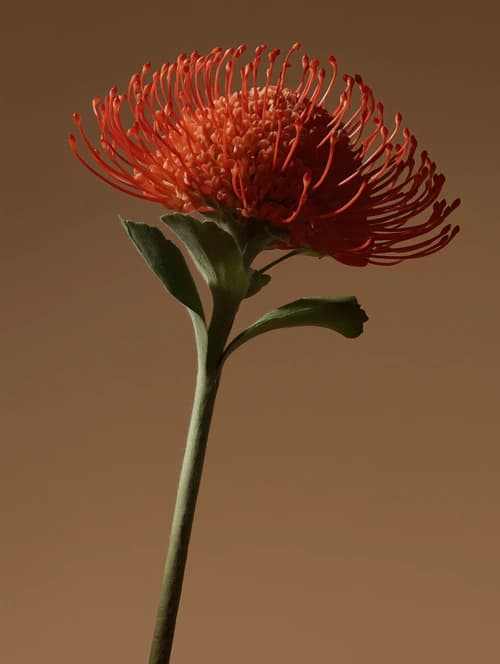
- Season
- March – April – May
- Vase life
- 5–8 days
- Latin name
- Fritillaria imperialis
- Colors
- Orange, Golden yellow, Brick red, Cream white, Deep violet, Brown-purple
The name Fritillaria covers several very different types. The imposing crown imperial (F. imperialis) reaches up to 80 centimetres and bears orange, yellow or brick-red bells. Persian fritillary (F. persica) is slimmer, with many dark violet to brown-purple florets arranged like a spike. The delicate snake's head fritillary (F. meleagris) stays small and charms with its namesake chequered flower pattern.
In floristry, Fritillaria is a statement, not a filler. A single crown imperial instantly gives a tall arrangement structure and height, while the fine-stemmed snake's head suits small, almost wild-looking spring pieces. We like to use the large varieties as solitaires or in groups of three so their distinctive form comes into its own.
Quality in Fritillaria shows in a firm, straight stem and buds of which only the lowest is slightly open. Ideally it is cut at exactly this stage, so the remaining bells open one after another in the vase. Limp or fully opened stems last noticeably shorter. Because we buy directly at the auction, the flowers reach us cool and without intermediate storage.
Stylistically, Fritillaria pairs with everything that breathes spring: tulips, ranunculus, anemones, narcissi and fresh greenery. Orange and brick-red crown imperials feel warm and baroque, the violet Persica varieties elegant and dark, the snake's head fritillaries romantic and natural. A note for the home: the crown imperial gives off a distinct, slightly pungent musky scent, said to deter voles, but noticeable indoors.
Is Fritillary toxic to children and pets?
- Children
- Toxic
- Cats
- Toxic
- Dogs
- Toxic
All parts of the plant, especially the bulb, are toxic to humans, cats and dogs due to alkaloids such as imperialine. Keep out of reach of children and pets.
Typical symptoms: Drooling, vomiting, diarrhoea and abdominal pain; larger amounts can also cause cardiovascular symptoms.
In an emergency:call the German poison control centre in Bonn on +49 228 19240 (24/7) — for pets, contact an emergency vet directly. This information does not replace medical or veterinary advice.
Overview: toxic & non-toxic plants for cats, dogs and children
Care
- 01Cut stems at an angle and place immediately in cool, clean water; flower food noticeably extends their life.
- 02Keep cool and out of direct sun; Fritillaria prefers conditions distinctly cooler than the average living room.
- 03Choose a spot away from ripening fruit and from radiators, as ethylene and heat speed up fading.
- 04Change the water every two days and keep the vase clean; the fleshy stems otherwise cloud the water quickly.
- 05When cutting, a slightly slimy sap seeps from the stem; wash hands afterwards, as all parts of the plant are toxic.
- 06Remove faded lower bells so the plant's energy goes into the still-closed buds.
Frequently asked
- How long does fritillary last in the vase?
- In a cool spot with clean water and flower food, fritillary stems usually last five to eight days. The cutting stage is decisive: stems with only the lowest bud slightly open keep developing and last longest.
- Is the crown imperial toxic to pets and children?
- Yes. All parts of Fritillaria, especially the bulb, contain toxic alkaloids such as imperialine and are toxic to cats, dogs and humans. Even the sap can irritate skin and mucous membranes. Keep the vase out of reach of children and pets and wash your hands after cutting.
- When is fritillary in season as a cut flower?
- Fritillary is a true spring flower, typically available from March to May. The window is short, so buying directly at the Rhein-Maas auction pays off to secure fresh, long-lasting A1-quality stems.
- Why does the crown imperial smell so strong?
- The crown imperial gives off a musky, slightly pungent scent meant to deter voles and other rodents. In the garden that is an advantage; indoors we recommend it for larger or well-ventilated rooms.