Plants
Snowflake
Leucojum · Amaryllidaceae
The snowflake — familiar to many as the spring snowflake or Märzenbecher — is the snowdrop's big sister: broader, bell-shaped flowers whose six equal-length petals each carry a green dot. It loves moist spots, naturalises magnificently there and flowers just when the garden needs white the most. We source our plants in nursery quality via the Veiling Rhein-Maas.
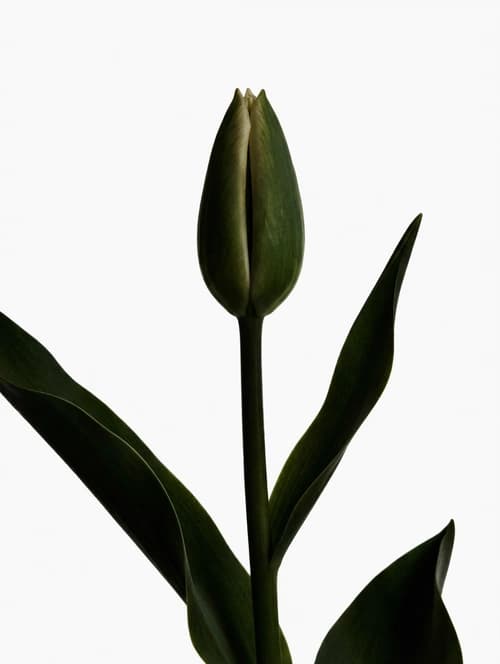
- Light
- Partial shade; bright enough beneath bare shrubs at flowering time.
- Watering
- Evenly moist to wet — the snowflake tolerates far more water than most bulbs.
- Care level
- Easy
- Botanical
- Leucojum
Two species matter in gardens: the spring snowflake (Leucojum vernum) flowers from February to April and grows to about twenty centimetres. The summer snowflake (Leucojum aestivum) follows from April to May, reaches sixty centimetres and carries several bells per stem — the cultivar „Gravetye Giant“ is the best known.
You can tell a snowflake from a snowdrop at a glance: its six petals are all the same length, forming a true bell with green dots at the tips. In the snowdrop, the three inner petals are clearly shorter than the three outer ones.
The decisive site factor is moisture: in the wild, the spring snowflake grows in floodplain woods that stand positively wet in spring. In the garden that means the moister and more humus-rich, the better: pond edges, stream banks, hollows or fresh woodland shade. The classic mistake is a dry, sandy spot where the bulbs fade away within a few years.
Planting is done in late summer or early autumn, about ten centimetres deep. As with snowdrops, dry-stored bulbs establish reluctantly; potted stock or divisions „in the green“ right after flowering are the safer choice. Once established, snowflakes form dense clumps for decades.
Honesty is due here as well: like all Amaryllidaceae, the snowflake is poisonous, especially the bulb. For borders and naturalised meadows that is uncritical, as long as children and pets do not eat plant parts and bulbs are not left lying around. Wild stands are protected and strictly off-limits.
Is Snowflake toxic to children and pets?
- Children
- Toxic
- Cats
- Toxic
- Dogs
- Toxic
Like snowdrops and daffodils, the snowflake contains toxic Amaryllidaceae alkaloids, most concentrated in the bulb. For cats, dogs and children: do not let them ingest any part and store bulbs out of reach.
Typical symptoms: After ingestion: drooling, nausea, vomiting, diarrhoea and abdominal cramps; larger amounts of bulb can also cause circulatory problems — then seek medical or veterinary help.
In an emergency:call the German poison control centre in Bonn on +49 228 19240 (24/7) — for pets, contact an emergency vet directly. This information does not replace medical or veterinary advice.
Overview: toxic & non-toxic plants for cats, dogs and children
Care
- 01Choose a part-shaded, moist spot — pond edges or woodland shade are ideal.
- 02Keep the soil humus-rich and evenly fresh to wet; drought is the biggest enemy.
- 03Plant bulbs about ten centimetres deep in groups in late summer.
- 04Let the foliage die back completely after flowering; do not cut it.
- 05Divide dense clumps right after flowering if needed and replant them moist.
- 06Wear gloves when handling bulbs and dispose of leftovers safely.
Frequently asked
- What is the difference between a snowflake and a snowdrop?
- The snowflake has six equal-length petals forming a rounded bell with a green dot at each tip; it is larger overall and flowers a little later. In the snowdrop the three inner petals are clearly shorter, giving the flower a two-tiered look.
- When does the spring snowflake bloom?
- The spring snowflake blooms from February to April depending on the site — its German name Märzenbecher captures the peak well. The summer snowflake follows from April to May, so both species together bridge almost four months of flowering.
- Is the snowflake poisonous?
- Yes, all parts are poisonous, the bulb most of all. The alkaloids match those of snowdrops and daffodils and mainly cause gastrointestinal upset. In households with digging dogs or small children, plant and store the bulbs out of reach.
- Why do my snowflakes disappear after a few years?
- Almost always the spot is too dry. The spring snowflake is a floodplain plant and needs permanently fresh to moist, humus-rich soil. Moving it to a damper place — ideally „in the green“ after flowering — usually solves the problem for good.