Flower Library
Cluster Lily
Brodiaea · Asparagaceae
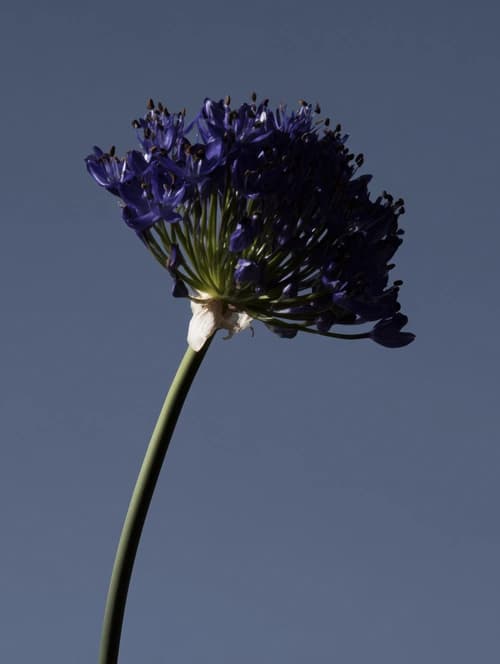
Brodiaea is a small, refined summer flower with great staying power: loose umbels of violet-blue star-shaped funnels on slender, leafless stems. As a filler and accent flower it brings that rare clear blue to summer bouquets and easily lasts one to two weeks. In the trade it is closely entwined with its sister triteleia — often under the same name.
- Season
- May – June – July
- Vase life
- 8–14 days
- Latin name
- Brodiaea
- Colors
- Violet blue, Blue-violet, Light blue, White
Botanically things are tangled: many flowers sold as brodiaea are today correctly assigned to the genus Triteleia — first and foremost the violet-blue ‚Queen Fabiola‘. True Brodiaea species such as Brodiaea californica or Brodiaea elegans appear less often. Luckily the naming dispute does not matter for the vase: looks, care and vase life are practically identical.
The umbels open their funnel-shaped florets one after another over many days. That is exactly what makes brodiaea so long-lived: as the first stars fade, the next buds push on. Simply pluck out the spent ones and the umbel keeps its shape.
Fresh stock shows firm, upright stems and umbels in which only a few florets are open while the buds already show colour. Soft stems or translucent, papery flowers are a sign of older lots.
In arranging, brodiaea is a lightweight in the best sense: the leafless stems slip effortlessly between larger blooms and give bouquets air and movement. Its violet blue is an ideal partner for white, pink and silver-green — from a summery meadow bunch to an elegant bridal bouquet.
The only care mistake worth mentioning is neglecting the water: in old, murky water the thin stems rot. Fresh water every two to three days and a clean recut — this uncomplicated flower needs nothing more.
Is Cluster Lily toxic to children and pets?
- Children
- Non-toxic
- Cats
- Non-toxic
- Dogs
- Non-toxic
Brodiaea is considered non-toxic to cats, dogs and people; the corms were even eaten by indigenous peoples of North America. We still advise against eating it — cut flowers do not belong on the plate.
Overview: toxic & non-toxic plants for cats, dogs and children
Care
- 01Cut the stems at an angle and place them in fresh water with flower food.
- 02Change the water every two to three days and rinse the vase.
- 03Regularly pluck out spent starry florets — the buds will open in their place.
- 04Display bright, cool and out of direct midday sun.
- 05Buy umbels with plenty of coloured buds; they keep developing in the vase.
Frequently asked
- How long does brodiaea last in the vase?
- Eight to fourteen days — the funnel florets of an umbel open one after another, stretching the display. With fresh water, regular recutting and plucking out spent stars you reliably reach the upper end of that range.
- Are brodiaea and triteleia the same flower?
- They are the closest of relatives and are often traded under both names. Many stems sold as brodiaea are botanically Triteleia laxa, such as the cultivar ‚Queen Fabiola‘. In looks, care and vase life there is practically no difference.
- Is brodiaea toxic to pets?
- No, it is considered one of the few pet-friendly corm flowers. For households with cats or dogs it is therefore a safe blue choice. As a rule, pets still should not nibble on cut flowers.
- What is brodiaea used for in floristry?
- As an airy filler and accent flower: its leafless stems with blue starry umbels loosen up summer bouquets and supply that rare clear blue. It suits daisies, lisianthus and gypsophila as well as delicate bridal work.