Flower Library
Dogs Tooth Violet
Erythronium · Liliaceae
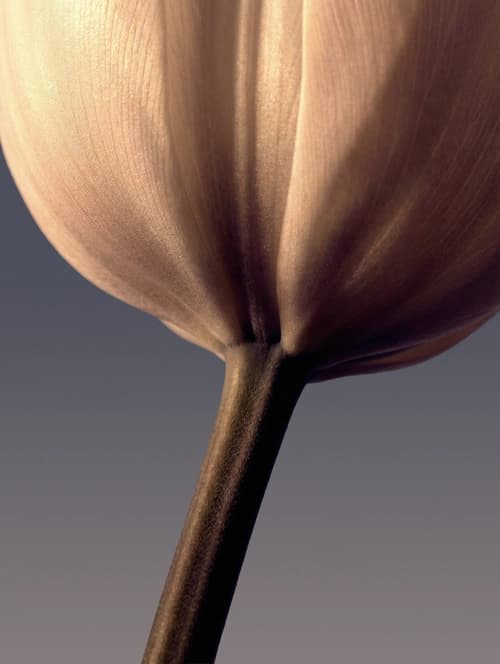
The dogs tooth violet is one of the most elegant spring flowers a florist can offer — and one of the rarest. Its nodding blooms sweep their petals upwards like little turbans, carried on a fine, arching stem. The curious name comes from the elongated white bulb that resembles a canine tooth. We buy it at the Veiling Rhein-Maas when the few spring lots appear — anyone who has had it in a bouquet once asks for it again.
- Season
- February – March – April
- Vase life
- 5–8 days
- Latin name
- Erythronium
- Colors
- Yellow, White, Pink, Violet
The cut flower trade is dominated by the strong yellow hybrid „Pagoda“, whose stems can carry several blooms. Alongside it come „White Beauty“ in creamy white and the pink to violet European species dens-canis. All stay fairly short at 20 to 35 centimetres — a scale for fine, small arrangements.
Botanically the dogs tooth violet belongs to the true lily family, making it a closer relative of the tulip and fritillaria than of violets, despite the English name. This kinship is also why we err on the side of caution and do not recommend it in cat households.
In floristry it is a flower for the second glance: its nodding posture and swept-back petals work best in loose, naturalistic spring bouquets — next to daffodils, fritillarias or forget-me-nots. In compact round bouquets the fine silhouette disappears.
Fresh stock shows upright, firm stems whose blooms are only just beginning to sweep their petals back. Fully open flowers with visibly shed pollen last only a few more days in the vase.
Like most spring bulb flowers, the dogs tooth violet likes it cool. The classic mistake is the warm living room table right next to the radiator: there it opens fully within hours and drops after two or three days. Kept cool it lasts about a week.
Is Dogs Tooth Violet toxic to children and pets?
- Children
- Mildly irritating
- Cats
- Toxic
- Dogs
- Mildly irritating
As a true member of the lily family, treat it as toxic to cats as a precaution and keep the vase out of reach, even though erythronium is not documented as highly toxic like Lilium. For dogs and children it is considered mildly toxic; do not ingest bulbs or plant parts.
Typical symptoms: After ingestion, drooling, vomiting and gastrointestinal irritation are possible; with cats, always consult a vet when in doubt.
In an emergency:call the German poison control centre in Bonn on +49 228 19240 (24/7) — for pets, contact an emergency vet directly. This information does not replace medical or veterinary advice.
Overview: toxic & non-toxic plants for cats, dogs and children
Care
- 01Recut the stems with a sharp knife and place them in a small amount of cold water.
- 02Keep it cool at all costs — the colder the spot, the longer the bloom.
- 03Do not combine with freshly cut daffodils; let daffodils drain their sap separately first.
- 04Check the water daily; the short stems quickly end up dry.
- 05Avoid direct sun and radiator heat, or the flowers open too fast.
- 06In cat households keep the vase out of reach (lily family).
Frequently asked
- Why is it called dogs tooth violet?
- The name refers not to the flower but to the bulb: it is elongated, pointed and ivory white — like a dogs canine tooth. The botanical species name of the European plant, dens-canis, literally means dogs tooth.
- Is erythronium dangerous for cats?
- The dogs tooth violet belongs to the true lily family, and with this family caution is always warranted around cats — even though erythronium is not documented as highly toxic the way Lilium is. In cat households we advise against it to be safe, or recommend keeping the vase out of reach.
- When are dogs tooth violets available as cut flowers?
- Only in a short window from about February to April, when the Dutch bulb growers cut. Volumes are small and it remains a speciality — if you want it for a specific date, let us know a few days in advance.
- How long does the dogs tooth violet last in the vase?
- In a cool spot around five to eight days. It is a typical short-lived spring treasure like fritillaria or anemone: not a marathon runner, but especially charming in its season. Warm spots halve the vase life.