Plants
Camellia
Camellia japonica · Theaceae
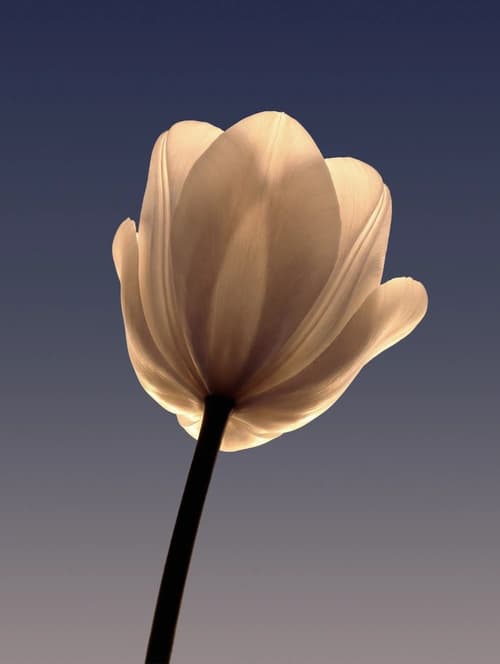
The camellia blooms while the garden sleeps: from December to April it opens elegant, almost porcelain-like flowers above glossy dark green foliage. It is the rose of winter — and tougher than its reputation suggests, provided the site and watering are right. In the mild Rhineland it even succeeds planted out in sheltered garden spots.
- Light
- Light to partial shade; strictly avoid winter sun on frozen foliage.
- Watering
- Evenly moist with low-lime water; summer drought costs the winter bloom.
- Care level
- Medium
- Botanical
- Camellia japonica
The range of varieties is enormous: from single wild-type blooms with a golden boss of stamens, through semi-double classics like ‚Donation‘, to perfectly double, geometric forms such as ‚Nuccio‘s Pearl‘. Camellia japonica flowers from late winter, the Camellia williamsii hybrids are considered more floriferous and garden-worthy, and Camellia sasanqua blooms as early as autumn and is scented.
The camellia is a close relative of the tea plant (Camellia sinensis) — the same genus that supplies the world's tea. Its needs betray its forest origins: light shade, acidic to neutral, humus-rich soil and even moisture with low-lime water, much like a rhododendron.
You need to know the bud secret: the flower buds are set as early as summer. Drought in July and August is the main reason camellias drop their buds in winter — consistent summer watering therefore secures next year's bloom.
In a container the camellia wants to spend winter cool and bright, at around 5 to 12 degrees in an unheated conservatory or stairwell. A warm living room is the surest route to bud drop. Planted out, it needs a spot sheltered from wind and winter sun, for example in front of a west-facing wall — the danger is not frost itself but morning sun on frozen leaves.
A lovely side effect for floristry: single camellia blooms float beautifully in shallow bowls, and the glossy foliage is a classic cut green — long-lasting, elegant and once a staple of every bridal workroom. As a token of admiring affection the camellia has a long tradition.
Is Camellia toxic to children and pets?
- Children
- Non-toxic
- Cats
- Non-toxic
- Dogs
- Non-toxic
The camellia is considered non-toxic to cats, dogs and children — one of the few lavishly flowering alternatives to the highly toxic azalea. As always, eating larger amounts is not advised.
Overview: toxic & non-toxic plants for cats, dogs and children
Care
- 01Choose light shade, sheltered from wind and winter sun.
- 02Plant in acidic to neutral, humus-rich soil — ericaceous compost works well.
- 03Water with low-lime water (rainwater) and never let it dry out completely.
- 04Water consistently in July and August — that is when next year's buds form.
- 05Keep container plants cool and bright at 5–12 °C in winter, not in a warm room.
- 06After flowering, trim lightly to shape if needed and feed with ericaceous fertiliser.
Frequently asked
- Is the camellia hardy?
- Partially: established plants of robust varieties survive temperatures around minus 10 to 15 degrees in mild wine-growing climates — including our Rhineland — if sheltered from wind and winter sun. In harsher regions the camellia is better kept in a container and overwintered cool and bright at 5 to 12 degrees.
- Why does my camellia drop its buds?
- The three main causes: drought in summer when the buds were forming; an overwintering spot that is too warm; or abrupt changes of position and temperature during the bud stage. Even moisture and a cool, stable winter spot almost always solve the problem.
- Is the camellia toxic to cats or dogs?
- No — the camellia is considered non-toxic to cats, dogs and people. That makes it an excellent choice for pet households, especially as a flowering winter alternative to the highly toxic indoor azalea it is often confused with.
- When does the camellia flower?
- Depending on species and variety, between December and April; the autumn camellia, Camellia sasanqua, even starts in October. Camellia japonica peaks in late winter — often from January in a cold conservatory, from March outdoors.
- Does the camellia tolerate hard tap water?
- Not in the long run: like its ericaceous relatives it responds to lime with yellowing leaves. Rainwater is ideal; if only hard tap water is available, let it stand or blend it with distilled water, and feed occasionally with an acidic ericaceous fertiliser.