Tulip Colours and Their Meaning
Red declaration of love, yellow friendship, purple regality — the tulip colour codes.
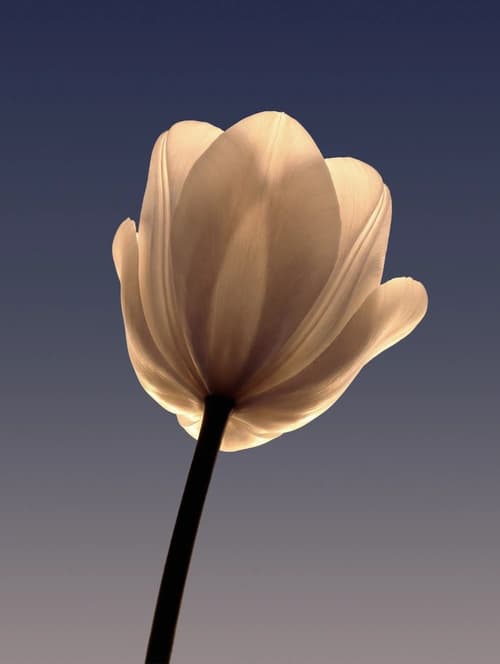
Tulips are the second-most symbolic cut flower after roses. Their colour codes are less strict, but worth knowing.
Red tulips: declaration of love — historically the strongest tulip symbol, almost as direct as a red rose. Reads softer and more personal in spring.
Yellow tulips: originally 'hopeless love' (Victorian era), today more friendship and cheer. Classically given at start of spring.
White tulips: purity, forgiveness, peace. Fits mourning floristry, also confirmations and First Communions.
Pink tulips: gentle affection, attention. Universal for family, friends, new parents.
Purple tulips: regality, elevation. Reads formal, good for anniversaries and business occasions.
Orange tulips: enthusiasm, energy, confidence. Popular at creative occasions — exhibition openings, award ceremonies.
Black tulips: mystery, depth. Rarely sold as single variety, often as accent in darker bouquets.
Colourful / multi-coloured tulips: 'beautiful eyes' — historically a compliment to the recipient. Today simply a cheerful gesture without fixed code.
Count: less strictly coded than roses. Classically given in even numbers (10, 12, 15, 20). A single tulip feels sparse, so usually minimum 5–7 stems.
Spring context: because tulips are so strongly associated with spring, they also communicate beyond variety: 'new beginning', 'fresh start', 'optimism'.
Frequently asked
- Which tulip colour for a first date?
- Soft pink or apricot. Red feels too direct for a first date, yellow sends friend signals. Soft pink hits the middle.
- Are black tulips really black?
- Visually yes, biologically deep purple or deep burgundy. True black doesn't exist in the plant world.
- Which tulip suits Mother's Day?
- Soft pink, peach, white. Red feels too romantic for mothers. Apricot or white-pink mixed bouquets are the recommendation.